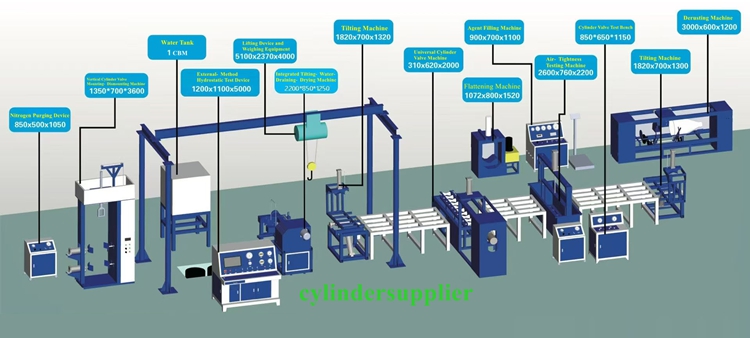
gas cylinder inspection line
25 August 2026The inspection line generally integrates multiple testing stations including nitrogen purging, cylinder valve mounting‑dismounting, internal cleaning, external surface treatment, visual inspection, wall‑thickness measurement, external‑method hydrostatic test, and air‑tightness test. It forms a streamlined production line, which improves inspection efficiency and guarantees inspection quality.
The design and manufacture of each piece of equipment for the gas cylinder inspection line shall comply with relevant national standards and technical specifications. Its technical parameters vary according to inspection subjects. Common inspection subjects include automotive gas cylinders with a nominal working pressure of 16‑25MPa and a nominal water capacity of 30‑200L.
Adopting streamlined operation, the inspection line connects each inspection procedure in sequence to realize fully‑automatic or semi‑automatic processing of gas cylinders covering the whole workflow from station entry registration to inspection completion.
This inspection line is mainly intended for periodic inspection of automotive compressed natural gas (CNG) steel cylinders and metal-lined composite cylinders with a fiber-wrapped hoop. It can also meet inspection requirements for various other cylinder types such as liquefied petroleum gas (LPG) cylinders and hydrogen cylinders.
The design and manufacture of each piece of equipment on the gas cylinder inspection line shall comply with relevant national standards and safety technical specifications. Inspection items cover visual inspection, wall‑thickness measurement, sonic inspection, cylinder neck thread inspection, hydrostatic test, and air‑tightness test.
Equipped with a computer control system, the gas cylinder inspection line enables automatic acquisition and processing of inspection data, and delivers functions such as pressure precision control and inspection report generation, thus improving inspection efficiency and data traceability.
The gas cylinder inspection line is applicable to the periodic inspection of compressed natural gas steel cylinders with a nominal working pressure ≤25MPa and a nominal water capacity of 30‑150 L. It can also satisfy the periodic inspection and evaluation of steel‑liner hoop‑wound cylinders of corresponding specifications.
The process flow of the inspection line is as follows:
Cylinder incoming registration → Cylinder loading onto inspection line → Nitrogen purging (completed by vacuum evacuation and nitrogen filling) → Cylinder valve removal (by chuck rotation) → Internal cleaning (rinsing with clean water and hot water followed by blow‑drying) → Plug installation → External‑surface rust removal of cylinder → Plug removal (for steel cylinders) → Visual inspection → Wall‑thickness measurement → Sonic inspection → Cylinder neck thread inspection → Internal inspection → Non‑destructive testing (for steel cylinders) → Empty‑cylinder weighing, data automatically transmitted to industrial personal computer → Water filling and screwing‑on of special connector → Full‑cylinder weighing, data automatically transmitted to industrial personal computer → Tightening water‑sleeve cover → Loosening cylinder body → Lifting cylinder into water sleeve → Automatic compressing and sealing of water‑sleeve cover → Pressure resistance test (computer‑controlled) → Releasing water‑sleeve cover → Lifting cylinder out of water sleeve → Unscrewing water‑sleeve cover → Tilting for water draining → Drying → Cylinder valve installation → Air‑tightness test (leak‑testing operated behind explosion‑proof wall) → Rolling to venting and nitrogen‑charging station → Connecting to manifold for gas venting and pressure relief (residual‑gas recovery) and nitrogen filling → Transferring cylinder to inspected‑cylinder storage area.